Electric Log Truck Feasibility & Field Validation
with Northwest Natural Resource Group
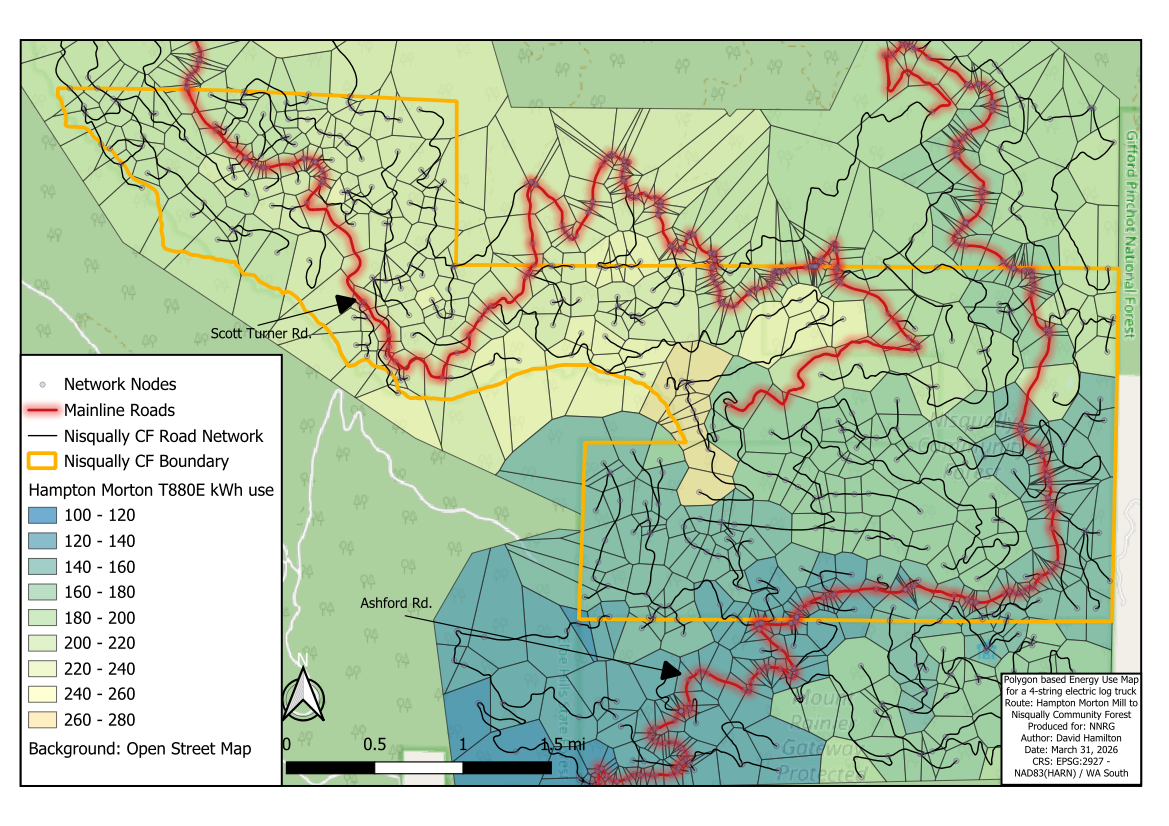
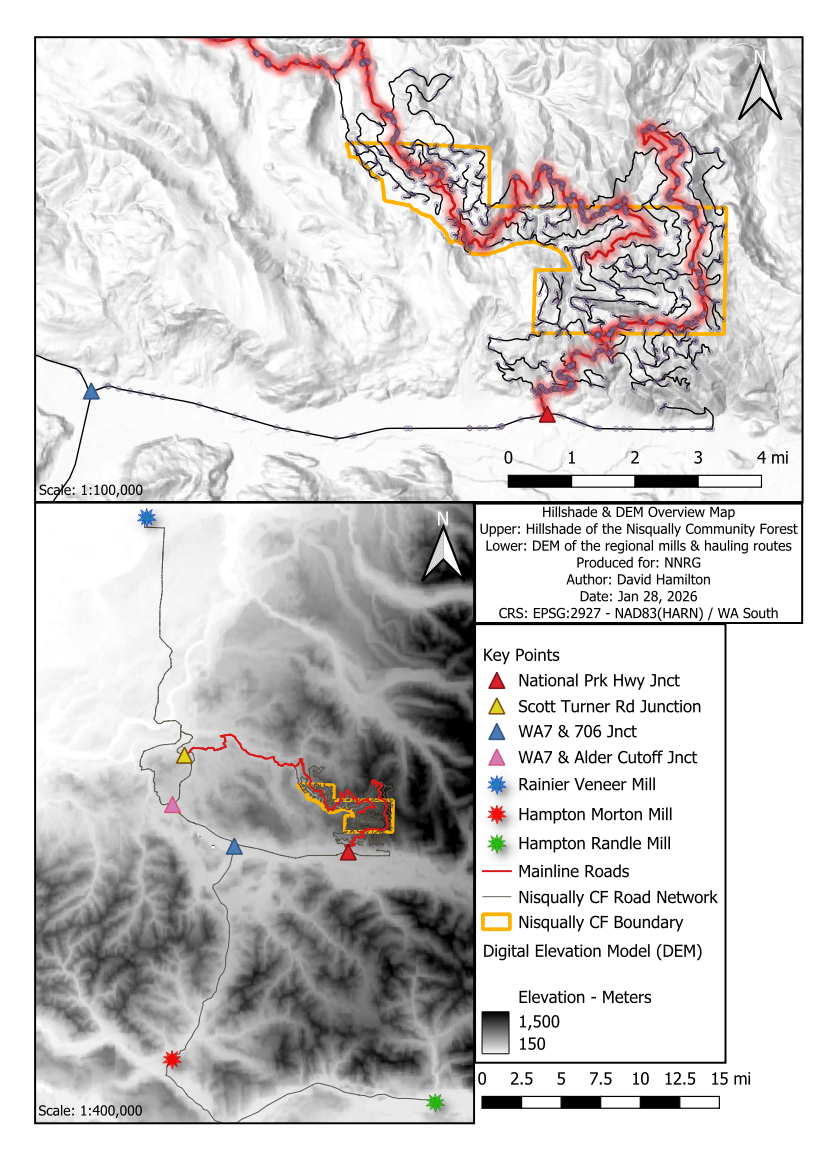
Mauka Energy is collaborating with Northwest Natural Resource Group (NNRG) to evaluate the feasibility of electric log trucks (ELTs) in Pacific Northwest forestry operations. Using real-world haul routes from the Nisqually Community Forest in Washington State, the project explores how battery-electric logging trucks can capitalize on steep terrain and regenerative braking to reduce emissions, improve energy efficiency, and lower operational costs. Preliminary analyses demonstrated that regenerative braking may substantially extend operational range on forestry haul routes with significant elevation change. More information about the project can be found in NNRG’s article, “Running the meter back—into the future”.
Mauka Energy’s role in the project centers on the BEVER (Battery Electric Vehicle Energy Routing) platform, a patented energy-routing and geospatial modeling system originally developed through research at Oregon State University. BEVER models how terrain, payload, road geometry, and regenerative braking affect heavy-duty electric vehicle performance in forest transportation networks. The system allows researchers and fleet operators to estimate route-specific energy demand, evaluate operational range, and identify charging opportunities for electric forestry fleets.
This collaboration represents an important step toward understanding how heavy-duty electric vehicles can be integrated into real-world forest operations. Supported through funding from the Centralia Coal Transition Board, the project helps advance practical decarbonization strategies for rural and resource-based transportation sectors while laying the groundwork for future field testing and operational validation of electric log truck systems.
Department of Energy
Small Business Innovation Research
FEVER project
Mauka Energy has been awarded a US Department of Energy (DOE) Small Business Innovation and Research grant to develop the FEVER tool and underlying technologies.
Given the remote nature of many jobs in rural communities, heavy duty EV buyers, like loggers, need accurate range estimations to ensure a vehicle can service their forest land. The forestry electric vehicle energy routing (FEVER) tool calculates the optimal route and maps energy cost across a landscape, allowing users to determine the maximum range of their service fleet.
Mauka Energy aims to embed the Forestry Electric Vehicle Energy Routing (FEVER) tool into heavy-duty trucks capable of regenerative braking; specifically, a electric vehicle configured for timber hauling. Simulations on forest landscapes indicate that in road systems where empty logging trucks gain elevation and full trucks lose elevation while delivering their heavy timber loads to mills, regenerative braking can reduce energy transportation cost and increase range. The embedded tool will allow operators of electric vehicles to select the most energy efficient route to their destination.
This project is the next step in the FEVER tool development.
During phase 1, the objective was to validate the current regenerative braking force estimation model in a field setting. The work occurred in the McDonald Dunn Research Forest because it was previously digitized for the simulation study, provides several hundred miles of road networks, elevation variance and multiple routes.
We are also partnered with Titan Freight Systems, a Portland based trucking company who are providing us with heavy duty EV trucks, specifically the Freightliner Ecascadia.


